
Art and Activism
in south & southeast asia today
A CONFERENCE HOSTED AT THE JEFFREY RUBINOFF SCULPTURE PARK, SEPTEMBER 11-13, 2026
In a time of socio-political turmoil, many in South and Southeast Asia are
looking to the arts for answers. The past decade has witnessed war, the rise and overthrow
of dictatorial regimes, erosion of democracy, and implementation of media censorship.
This conference addresses how visual artists across the region use their work to expose
injustices when other forms of protest are impossible. “Art and Activism in South and
Southeast Asia Today” is an interdisciplinary conference bringing visual artists
together with scholars and graduate students to explore the interface of art, ethics, and
social change across contemporary South and Southeast Asia.
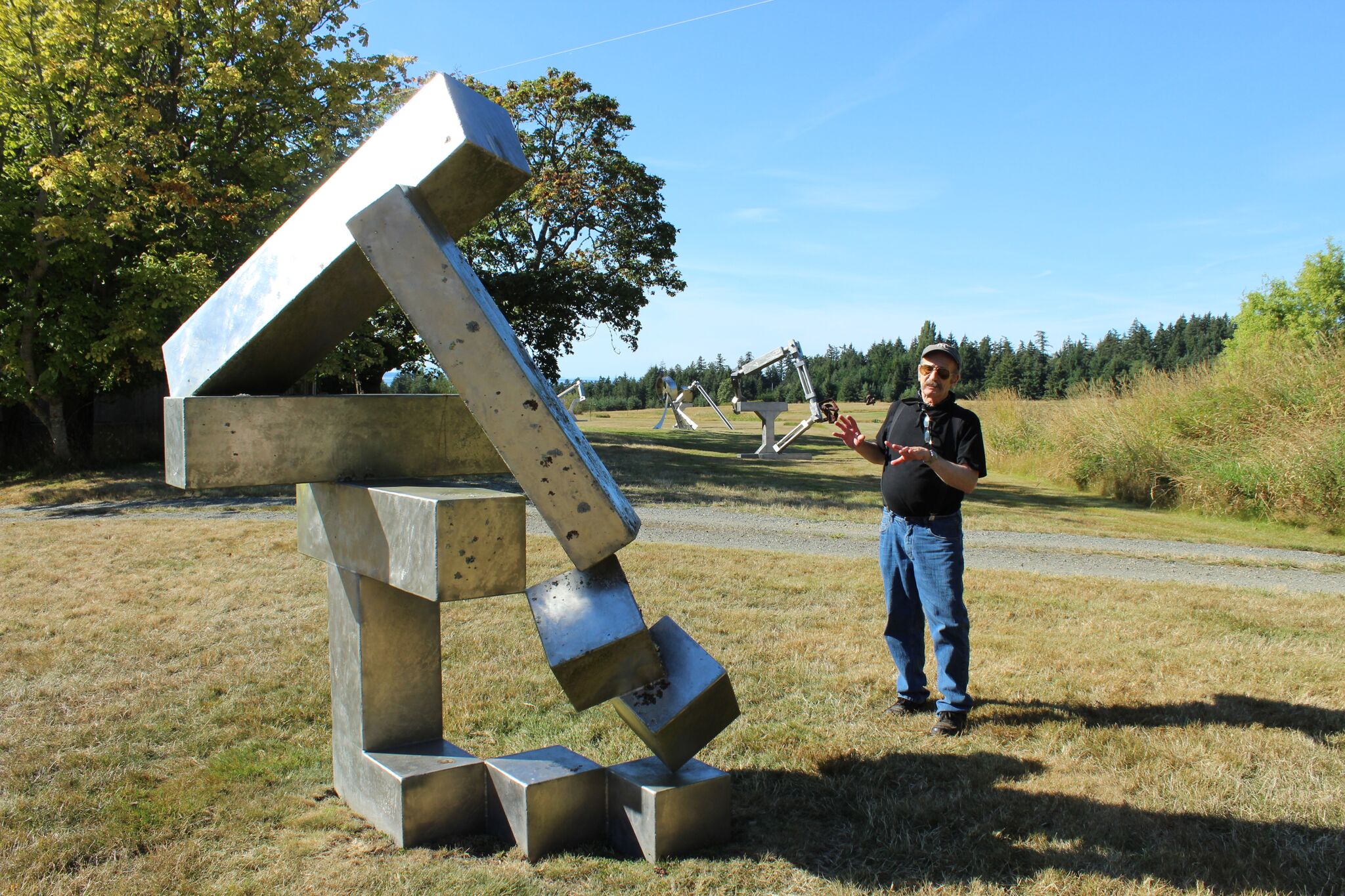
Jeffrey Rubinoff believed art could be a means of overcoming the social forces that divide us, bringing us into contact
with “humanism . . . the conceptual thread with which to weave common understanding”
(Jeffrey Rubinoff, “Insights” in Rubinoff on Art, 2).
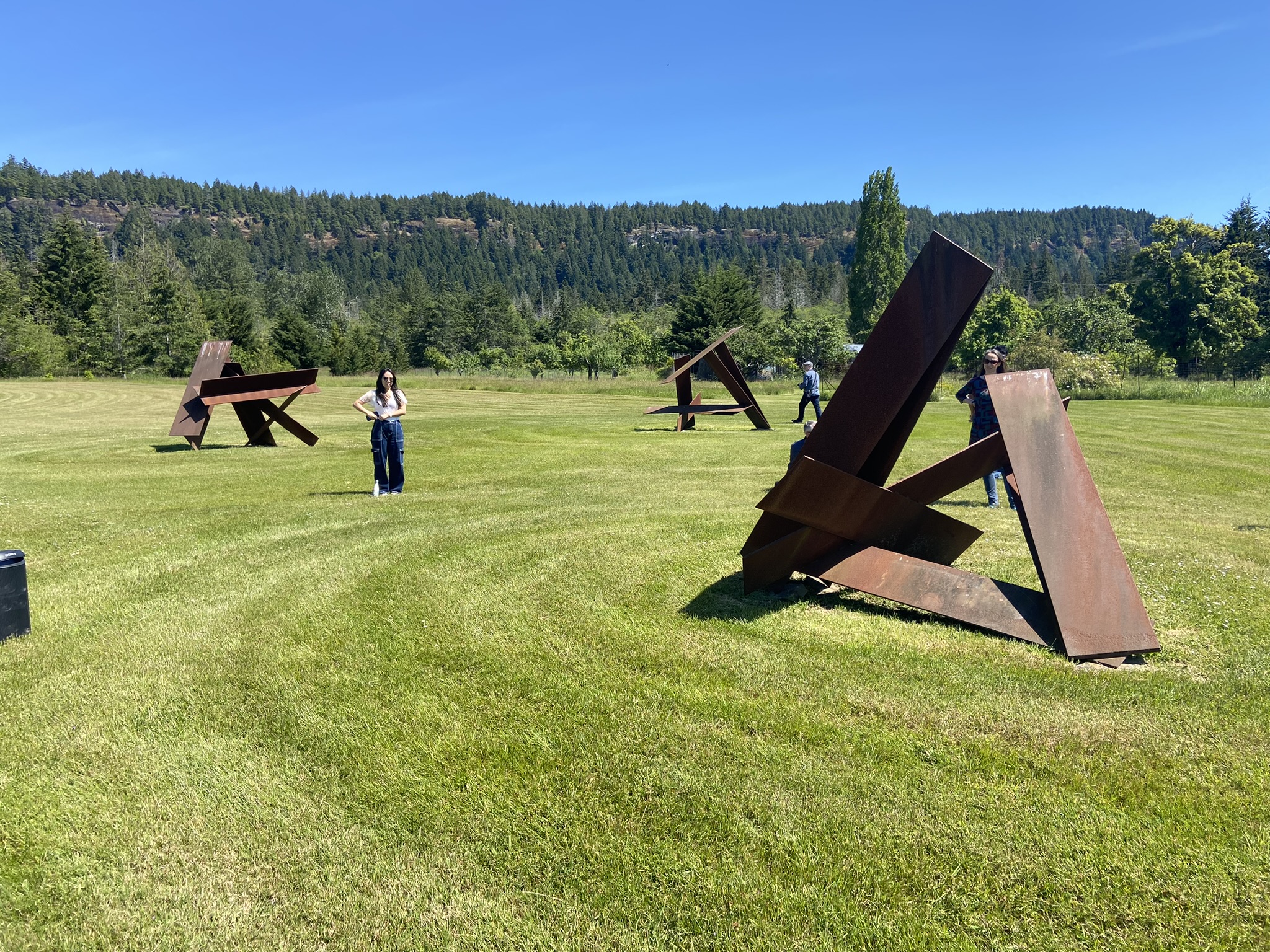
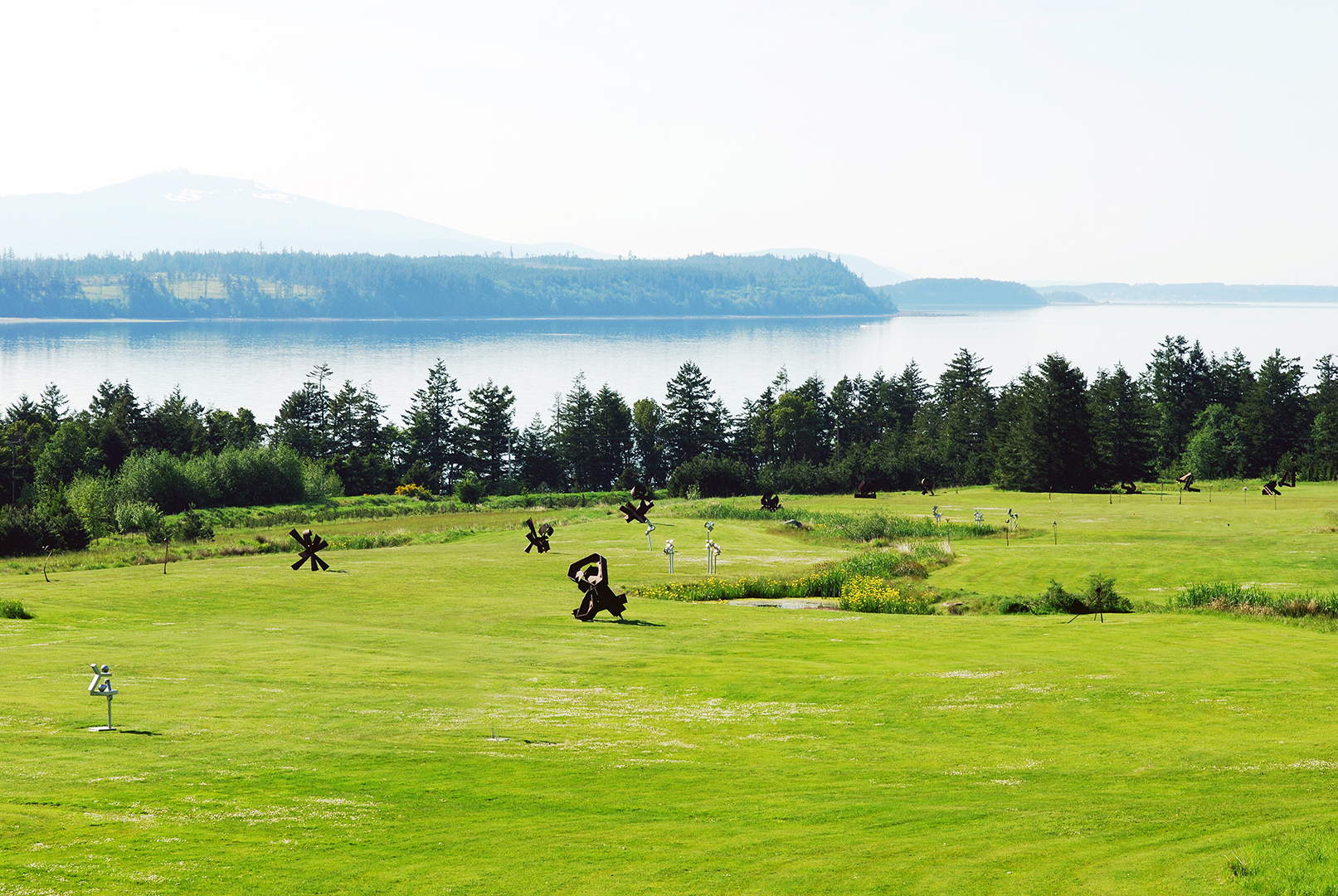
Holding the conference at the Jeffrey Rubinoff Sculpture Park is an opportunity to enhance the JRSP’s role as a
vital hub for new ideas in conjunction with the University of Victoria’s Art History and Visual Studies Department.
The Jeffrey Rubinoff Sculpture Park is located on the ancestral unceded territories of the K’ómoks, Wei Wai Kum, We Wai Kai, Tla’amin and the Homalco First Nations. The board of the Jeffrey Rubinoff Sculpture Park would like to express our gratitude to these Nations that we may use this land to enrich all who seek growth through art.

Melia Belli-Bose
Associate Professor, University of Victoria, Art History & Visual Studies.
Melia Belli Bose is a specialist in the visual cultures of early modern and contemporary South Asia. She received her PhD in 2009 from the University of California, Los Angeles and her undergraduate and master’s degrees from the School of Oriental and African Studies, University of London. Melia has spent several years in different parts of India, Pakistan, and Bangladesh, studying languages, conducting research, and hiking in the Himalayas. Her research and language study have been supported by the American Institute of Indian Studies, the Asian Cultural Council, and the American Institute of Bangladesh Studies.
Allan Antliff
Professor, University of Victoria, Art History & Visual Studies.
Allan began his appointment as Canada Research Chair at University of Victoria in 2003 and is currently the Jeffrey Rubinoff Legacy Chair in the Faculty of Fine Arts. His research focusses on anarchist studies, modernism and contemporary art. He has authored three books and is editor of Only a Beginning, an anthology of the anarchist movement in Canada. Active as a theorist and art historian, he has written on a wide range of topics including pedagogy; post-structuralism; new media; theater; protest movements, and aesthetics. In his role as art critic, he has published numerous art reviews and feature articles in journals such as SubStance, Canadian Art Magazine, C Magazine, and BlackFlash. He has also contributed to exhibition catalogs for the Musee Du Luxemburg, Whitney Museum of Art, the Vancouver Art Gallery and other institutions. He has produced two feature programs for CBC Radio (Guernica: A Political Odyssey, 2007; Anarchy, Art and Activism, 2002).
Schedule
10:30-12:00. Panel: counter-archives: Ashfika Rahman (keynote speaker), Amina Ejaz, Mehwish Abid Abaidullah
Archives are loci of power that privilege hegemonic voices and versions of history. Rahman, Ejaz, and Abaidullah present alternative/counter archives they either personally create or research. Their work centers agency, affect, embodied experience, and/or the individual’s relationship to power and place. While addressing different communities and sites, each presentation explores the roles of memory, resistance to erasure, and the material (the body or personal effects) to understand different manifestations of “the archive” and the production of historical knowledge.
12:00-12:50. Panel: Homeland: resistance through self-representation: Fuyubi Nakamura and Mohammad Zaki Rezwan
Colonial states throughout the world frequently present occupied land and its Indigenous inhabitants according to self-serving narratives that omit political violence, ecological degradation, and “modernization” efforts. In such narratives, Indigenous voices and lived realities are nowhere to be found. To ensure the primacy of their narrative, colonial states restrict movement in occupied land and censor news and communication. Nakamura and Rezwan explore Indigenous self-representation (Tibetan and Jumma Bangladeshi respectively) as a site of resistance to dominant state narratives and a pathway to reclaim agency and pride.
12:50-1:50 Lunch + tour of Sculpture Park
1:50-2:40. Panel: Domesticity and Danger: Rebecca Brown, Sandeep Johal
Presentations in this panel bring together very different examples— one in Kerala, India, the other in the Indian diaspora— of confluences of gender violence, labor, art, and domesticity into conversation. Brown and Johal present culturally systemic instances of violence against women through media that center disarming beauty (Punjabi folk art) or comfort and enjoyment (home-cooked meals).
2:40-3:30 Panel: Grass-roots resistance to hegemonic narratives: Rebecca Hall, Leyla Shirazi
Nationalist agendas promote a singular dominant historical narrative; linguistic, ethnic, and often religious homogeneity, and demand wholesale buy-in by citizens. In times of rising authoritarian nationalism across the world, art offers a way to record dissent, difference, and ideological refusal. Hall analyzes an example of protest against nationalism through cultural activism in northern Thailand, while Shirazi offers the example of her own art created in response to the Iranian state’s oppression and censorship of its citizens (2025-ongoing).
3:30-3:45 Break
3:45-4:45: Panel: Art, ambiguity, reception, and meaning: Boreth Ly, Shabbir Hussain Mustafa (keynote)
We all recognize art can play a vital role in asserting our humanity in the face of oppression. Yet, art often enters into spaces of ambiguity in the articulation of these values. As Ly examines through an in-depth case study of an iconic photograph, the ambiguity may lay the artwork’s afterlife. Mustafa approaches this issue through a curatorial lens, examining aspects of art that simultaneously address human rights abuses and probe other aspects of our being.

Guest Abstracts
Shabbir Hussain Mustafa
Chief Curator, Singapore Art Museum.
Sly Tropicality.
This keynote approaches the relationship between art and human rights through a curatorial “squint”: a deliberately oblique way of looking that attends to what becomes visible when we resist the urge to organise artistic practice too quickly around injury, representation, censorship or redress. Human-rights discourse remains essential for naming violations, defending freedoms and holding institutions to account. Yet art often exceeds this grammar. It does not only document the world as it is, nor merely demand a more just place within it. It can produce other registers of experience: unofficial memories, fugitive associations, speculative histories, forms of self-organisation, dream states, contradictions, and ways of inhabiting reality that are not fully captured by law, the state, the museum or the market. Drawing on two decades of curatorial practice in and from Southeast Asia, the keynote develops the idea of sly tropicality as a disposition rather than a doctrine: restless, tactical, self-questioning, and resistant to singular forms of authority. It asks what happens when we understand artistic freedom not only as the protection of expression, but also as the capacity to move between different realities without forcing them into coherence. Mustafa approaches this question through a curatorial ‘squint,’ considering how art can exceed the language of rights and open onto unofficial memories, speculative histories, forms of self-organisation and other ways of inhabiting reality.
Shabbir Hussain Mustafa is Chief Curator at the Singapore Art Museum (SAM), where he oversees the museum’s programming at its new post-industrial spaces. From 2023 to 2025, he was Senior Curator and Head of Exhibitions at the Guggenheim Abu Dhabi, contributing to the development of the museum’s curatorial framework. He has also held senior curatorial roles at National Gallery Singapore. He currently serves as a Board Member of CiMAM, a global network of modern and contemporary art museum professionals that supports critical discourses on museological futures, and as the Artistic Director of Aichi Triennial 2028, one of Japan’s leading international festivals of contemporary art.
Leila Shirazi
Artist.
Pardis.
Pardis is a personal reflection on distance, violence, fractured communication, and the body as a site of memory. Written from Southeast Asia during the internet shutdowns in Iran, the paper traces my attempts to reach my family as images, reports, silences, and contradictory accounts arrive through my smartphone. It asks when news ceased merely to mean something new and became something the body fears receiving. The text moves through two conceptual spaces. The first is barzakh, understood not simply as a space between two worlds, but as the condition of belonging to both while being able to act fully in neither. The second is Pardis, a word signifying garden and paradise in Farsi, while in Urdu it points toward a foreign land. Pardis becomes a place where shelter and exile, safety and fear, coexist without cancelling one another. Through dysconnectivity, the text considers forms of communication that arrive fractured, and the ways distance fails to keep violence at a distance. It merely changes its route of entry into the body. Hall analyzes an example of protest against nationalism through cultural activism in northern Thailand, while Shirazi reflects on distance, and the body as a site of memory, considering how violence is experienced from afar through silences and disrupted forms of connection.
Leila Shirazi is an artist based in Singapore. Her practice explores landscape, memory, language and survival. Working across painting, drawing, performance and culinary workshops, she draws on Persian and Mughal miniature traditions to construct new cosmological narratives. Her long-term research into the oil palm, developed through The Good Seeds, traces plantation histories across Southeast Asia. More recently, her practice has expanded into sculpture and textiles while continuing to engage with miniature painting as both a historical archive and a speculative language. She was Artist in Residence at the Cultural Foundation, Abu Dhabi, in 2024, and with Kontempo at Ayala Foundation, Manila, from 2026–27. Her work has been exhibited internationally and is held in private and public collections, including KADIST.
Boreth Ly
Chair, Associate Professor in History of Art and Visual Culture, University of California, Santa Cruz.
The Politics of Legibility in Malcolm Browne’s 1963 Photograph of Buddhist Monk Performing Self Immolation on the Street of Saigon.
Malcolm Browne took a startling photograph in 1963. Titled “Buddhist Monk’s Suicide Protest,” it is arguably among a group of iconic photographs taken by American photographers from the Vietnam-American War. The monk’s act of self-immolation has inspired and been copied by many similar Buddhists and political activists around the world. Moreover, Browne’s photograph has been reproduced widely in different media including an album cover for Rage Against the Machine. Although the photograph has been taken to represent a violent form of protest, it resists such simple readings. This paper examines the historical and religious contexts of the ritual performance captured by Browne’s photograph and argues that until this very day, the religious and ritual meaning of this seemingly violent act obscures any attempt to frame this photograph as clearly legible.
Born in the cosmopolitan village of Phnom Penh, Cambodia, Boreth Ly is an associate professor of Southeast Asian art history and visual culture at the University of California, Santa Cruz. Academically trained as an art historian, Ly employs multidisciplinary methods and theories in her writings and analysis, depending on the subject matter. One of her research areas focuses on the intersection between memory and historical trauma. Her recent book, Traces of Trauma: Cambodian Visual Culture and National Identity in the Aftermath of Genocide (University of Hawai’i Press, 2022), is concerned directly with the topic of memory. She coedited a book with Nora A.Taylor titled Modern and Contemporary Art of Southeast Asia (2012), and she has written numerous articles and essays on the arts and films of Southeast Asia and its diaspora. Currently, he is working on topics related to gender, material culture, memory, and historical erasure.
Ashfika Rahman
Artist.
Archives of the Unheard: Art, Community, and Counter-Histories.
In this presentation, Bangladeshi visual artist and educator Ashfika Rahman will discuss her long term artistic and pedagogical practice, which she describes as a form of “archivism” an ongoing process of creating alternative archives that emerge from lived experience, collective memory, and community collaboration. Working closely with marginalized communities in Bangladesh, Rahman investigates histories and realities that are frequently erased, censored, or excluded from official state narratives and dominant cultural discourse. Through research-based, mixed-media installations, her practice engages with questions of memory, displacement, structural violence, environmental precarity, and the enduring legacies of colonialism and social exclusion. Drawing on mythological, spiritual, and folk traditions, she reinterprets inherited narratives as tools for understanding contemporary political conditions. Rather than treating archives as static repositories of information, Rahman approaches them as living, evolving structures shaped by the voices and agency of those whose experiences they seek to preserve.
The presentation will examine how localized histories from Bangladesh resonate within broader global frameworks of power, migration, ecological crisis, and social inequality. By foregrounding stories that often remain invisible within mainstream media and elite cultural institutions, her work seeks to create spaces for political visibility and collective remembrance while contributing to a more inclusive understanding of historical knowledge. Rahman will also discuss her ongoing pedagogical initiative, the Boat School, a floating platform for creative learning and cultural exchange in rural Bangladesh. Developed in response to geographical isolation and climate-related challenges, the project provides communities with tools to articulate, archive, and share their own experiences. Through both artistic and educational practice, Rahman explores how collaborative forms of knowledge production can challenge systems of exclusion, strengthen community agency, and connect local struggles to wider global conversations on justice, representation, and cultural memory.
Ashfika Rahman is a Bangladeshi visual artist whose multidisciplinary practice explores the histories and lived experiences of marginalized communities. Through mixed-media installations, she creates living archives that challenge dominant narratives and foreground voices often excluded from official histories. Drawing on mythological, spiritual, and folk traditions, Rahman
reinterprets cultural narratives within contemporary social and political contexts, addressing themes of memory, displacement, violence, and systemic marginalization. A graduate of Hochschule Hannover, Germany, and Pathshala South Asian Media Institute, Bangladesh, where she later joined the faculty, Rahman received the Future Generation Art Prize (2023–2024) awarded by the Victor Pinchuk Foundation. Her work has been exhibited internationally at institutions and events including Palais de Tokyo, France; Fondazione Sandretto Re Rebaudengo, Italy; Dhaka Art Summit, Bangladesh; Busan
Biennale, South Korea; Art Basel, Switzerland; Frieze London, United Kingdom; and the Venice Biennale 2026. Committed to alternative art education, she also initiated a floating boat school in Bangladesh. Rahman is currently an artist-in-residence at the Rijksakademie van beeldende kunsten (2024
2026).
Rebecca Brown
Professor, History of Art, Johns Hopkins University, Baltimore.
We watch as she moves between the fire and the stove, stirring here, stoking here. She pauses, hand readied above a curved skillet. She watches, we watch. A beat. A breath. She tosses the chopped onion at the pan, raising a sharp sizzle of oil and we release the breath we didn’t know we were holding. She regains her frenetic rhythm.
This scene, at the center of Jeo Baby’s The Great Indian Kitchen (2021), offers a rare respite from the unrelenting pressure and repetition of the main character’s daily labors. TGIK unfolds through a series of long scenes set in the kitchen, the hub of the unnamed woman’s life we are witness to. On one level, the film is a simple feminist statement. By showing the workings of the titular kitchen to be a space of repression, rage, and helplessness, the film forces audiences to recognize and empathize with the hidden labor of women.
But the film also exceeds that framing: it moves beyond the exposure of the truth to show the slow unraveling of a subject, so that we see the continual maintenance people do to blind themselves to the slow-motion murder happening in the Great Indian Kitchen and the Great Global Kitchen. To unpack this, I put TGIK in conversation with two kitchen-centered works: Martha Rosler’s Semiotics of the Kitchen and Chantal Akerman’s Jeanne Dielman, 23 quai du Commerce, 1080 Bruxelles (both 1975); and with two films that bring us into the feminist politics of an unraveling mind: Todd Haines’s Safe (1995) and Pablo Larraín’s Spencer (2021).
Rebecca M. Brown is Professor of the History of Art and Chair of the Museum Studies and Cultural Heritage Management programs at Johns Hopkins University. Her books include Art for a Modern India, 1947–1980 (2009), a critical engagement with modernism in the decades after decolonization, Gandhi’s Spinning Wheel and the Making of India (2010), which traces the genealogy of spinning and the anti-colonial movement of the early twentieth century, Displaying Time: The Many Temporalities of the Festival of India (2017), a study of the diplomatic, museological, and cultural machinations of the long 1980s, and Modernism in Relation: KCS Paniker’s Written Pictures (2026), which follows the southern Indian painter as he seeks out a language of painting. She has co-edited seven volumes and special issues on photography, craft, place, and the art of Asia, and has curated exhibitions and consulted for museums and galleries in North America, Europe, the UK, and India.
Rebecca Hall
PhD, Independent scholar.
Painting Cultural Resistance: Contemporary Temple Murals in Northern Thailand.
Contemporary Buddhist temple murals in Northern Thailand increasingly depict local histories and cultural practices alongside canonical Buddhist narratives. Although these murals initially appear to celebrate local history and community pride, they also challenge the cultural hierarchies produced through Thai nation-building in the late nineteenth and early twentieth centuries. Drawing on a visual analysis of recently painted murals at three Buddhist temples in Chiang Mai Province, I argue that locally informed murals function as acts of cultural activism when understood against the backdrop of Thai state policies that promoted cultural homogenization and marginalized regional histories in service of a centralized national identity. Reading these murals as forms of visual activism reframes Buddhist temple painting not merely as devotional or commemorative art but as a medium through which local communities challenge the legacies of internal colonization and assert cultural continuity.
Rebecca S. Hall is an art historian and curator specializing in the arts of Southeast Asia. She served as Curator at the USC Pacific Asia Museum (2018–2025), where she organized exhibitions on Asian textiles, contemporary art, and Southeast Asian visual culture, with an emphasis on engaging Los Angeles’s Asian diasporic communities. She holds a PhD in Southeast Asian art history from UCLA and has conducted fieldwork in Thailand, Laos, and Cambodia. Her research examines the intersections of Buddhist art, community practice, cultural heritage, and contemporary artistic production, with recent publications addressing Buddhist visual culture and Cambodian cultural heritage in U.S. museum collections.
Fuyubi Nakamura
Associate Professor, Asian Studies & Curator, Asia at the Museum of Anthropology, the University of British Columbia (UBC).
Tibet through “Entangled Territories”.
The paper presents Entangled Territories: Tibet Through Images, an exhibition Nakamura curated. The exhibition was developed in collaboration with members the Tibetan-Canadian community including two artists. The exhibition reimagines Tibet by showing how Tibet has historically been represented by outsiders and how Tibetans themselves now present and talk about Tibet. It showcases Tibet and Tibetans through their lenses and voices. Following China’s Communist Revolution in 1949, Tibet was forced to surrender its independence and has been under China’s occupation since 1951. For over seven decades, the political situation has resulted in the continued displacement of Tibetans and their global relocation, forming what is now the Tibetan diaspora. Many of those who identify as Tibetan were not born within nor do they live in Tibet, but reside elsewhere, often in India and Nepal and increasingly in North America and Europe. Canada is home to one of the largest concentrations of Tibetans outside of Asia. The location and status of the Tibetan homeland remain a critical issue for Tibetans, especially for younger generations outside Tibet. Entangled Territories uplifts the efforts of the Tibetan-Canadian community to maintain their culture and history in the face of challenges associated with migration and the loss of their homeland.
Fuyubi Nakamura (中村冬日) is a socio-cultural anthropologist trained at the University of Oxford. She is an Associate Professor in the Department of Asian Studies and Curator, Asia at the Museum of Anthropology, the University of British Columbia (UBC). She specializes in the anthropology of art, museum studies, and material and visual culture studies. She taught at the Australian National University (2007–2010) and University of Tokyo (2012–2013), and curated exhibitions internationally prior to joining UBC in 2014. Her research through exhibition curation includes Traces of Words: Art and Calligraphy form Asia (2017), A Future for Memory: Art and Life after the Great East Japan Earthquake (2021) and Entangled Territories: Tibet Through Images (2025–2026). Her publications include Asia through Art and Anthropology (Bloomsbury Academic, 2013) and Hokkaidō 150: Settler Colonialism and Indigeneity in Modern Japan and Beyond in Critical Asian Studies, 2019.
Sandeep Johal
Artist.
How can art speak about femicide and so-called honour killings without reducing women to the violence inflicted upon them? This question sits at the centre of my practice. As a Punjabi Canadian artist, I grapple with the responsibility of creating work that confronts men’s violence against women within my own cultural context while resisting stereotypes that reduce South Asian communities to violence alone.
My practice is rooted in beauty as an entry point—one that invites viewers to slow down, look closely, and engage with the layered meanings embedded within the work. Rather than centering images of violence, I use symbolism, metaphor, and the rich visual language of Punjabi folk art traditions to explore what contemporary art can reveal about the emotional, cultural, and personal realities that statistics and news reports alone cannot convey. My work creates spaces where grief can be held, violence can be questioned, and remembrance can become a form of resistance. In this presentation, I will discuss how my practice navigates the ethics of representing violence against women and how visual storytelling can make visible what silence seeks to conceal. Through my work, I ask audiences to look beyond the act of violence alone—to recognize the patriarchal systems that sustain it, the narratives that normalize such violence, and the lives and stories that must be remembered.
Sandeep Johal is a Canadian visual artist whose practice engages drawing, collage, textiles, and large-scale murals. Through her Indo-folk feminine aesthetic, she confronts themes of bleakness, despair and ugliness with their dissonant opposites: brightness, hope and beauty. Johal’s work typically centers around the stories of women and while she highlights female suffering in its many forms, these are ultimately stories of resistance and resilience. Johal has worked on a number of notable site-specific commissions with the Confederation Centre of the Arts, Vancouver Art Gallery, Burrard Arts Foundation, and Indian Summer Festival. Her work is held in corporate, private, and institutional collections, including the TD Bank Collection, the Surrey Art Gallery, and the Gordon Smith Gallery of Canadian Art. Johal holds a Diploma in Fine Arts (honours) from Langara College (2007) and a Degree in Education from the University of British Columbia (2002). She lives and works in Vancouver, BC.
Mehwish Abid
Architect, artist & PhD candidate, Peter Guo-hua Fu School of Architecture, McGill University.
Listening to Domestic Archives: Artistic Practice and Archival Authority.
This paper explores how artistic practice reimagines the archive through the domestic sphere. Drawing on my ongoing research-creation projects, The Archive of Repair and Decolonizing Home through Objects, and their successive iterations at Harvard University, Kitchen to Kacheri (Delhi), the Lahore Museum, Alhamra Art Gallery, and most recently Tidal Paths (2026) at an[other] space, Lahore, it examines how exhibitions assembled through family photographs, inherited objects, domestic furniture, oral histories, and sound invite new ways of listening to domestic archives.
Developed through research-creation and informed by oral history, these installations invite visitors to handle photographs, move through suspended images, encounter inherited furniture, and listen to layered voices. The archive is approached not as a fixed institutional repository but as a lived, relational, and participatory practice, where memory is continually shaped through care, conversation, and embodied experience.
The paper considers how these artistic strategies engage cultural activism by asking where archives reside and how historical knowledge is produced. Rather than locating the archive solely within institutional collections, the installations foreground the home as a site where memory is assembled, shared, and sustained through everyday relationships. In doing so, they suggest that artistic practice can reshape archival authority by opening historical knowledge to the material, sensory, and relational life of the home.
Mehwish Abid Abaidullah is an architect, artist, and PhD candidate in the Peter Guo-hua Fu School of Architecture at McGill University. Her work brings together architecture, artistic research, and curatorial practice to explore questions of memory, archives, and domestic space in South Asia. She is the founder of The Archive of Repair and Decolonizing Home through Objects, two ongoing research-creation projects that investigate the relationship between material culture, oral history, and exhibition-making. She was a Visiting Artist Fellow at the Lakshmi Mittal and Family South Asia Institute at Harvard University (2022), a Hamad Bin Khalifa Symposium on Islamic Art Fellow (2025), and is the recipient of the Fonds de recherche du Québec Doctoral Scholarship. She is currently completing her PhD dissertation, Home as Archive: Post-Partition Housing in Lahore (1947–1977), at McGill University.
Mohammad Zaki Rezwan
PhD student, Art History & Visual Studies, University of Victoria.
Ecological Framings of Indigeneity in Joydeb Roaja’s Go Back to Roots (2020).
I examine how Tripura artist Joydeb Roaja’s 2020 drawing series, Go Back to Roots (2020), reflects the struggles of Jumma communities in the Chittagong Hill Tracts of Bangladesh. Roaja’s work calls attention to the oppression of Indigenous peoples and how the militarization of their lands has led to the erasure and suppression of their cultural identities. Revealing the decades-long hegemonic enforcement of Bengali nationalism, the series incorporates Indigenous epistemologies to underscore the lived experiences and collective resilience of these communities. I argue that Roaja establishes an ecological worldview to reconnect these vulnerable communities with their land and defend their unique identities against misrepresentation and stereotyping. By depicting mundane moments from the everyday lives of Indigenous communities, the artist illustrates how their realities are inseparably entangled with nature and its diverse constituents. The paper applies Mitchell Thomashow’s theory of Ecological Identity to analyze the representation of Indigenous peoples in Roaja’s work, demonstrating how their cultural identities are rooted in the earth and its ecological systems. It also highlights how such reconstructions of Indigenous identities function as a form of resistance against the violence, enforced disappearance, and inequality these communities encounter in Bangladesh.
Mohammad Zaki Rezwan is a PhD student in the Department of Art History and Visual Studies at the University of Victoria. His doctoral research explores the exhibition history of Bangladeshi art and visual culture. Currently on study leave, he is a Senior Lecturer in the Department of English and Humanities at BRAC University, Bangladesh. He holds an MA in Comparative Media Arts from Simon Fraser University and an MA in Literatures in English and Cultural Studies from Jahangirnagar University. In 2019, he curated the exhibition Unveiling at Centre A, the Vancouver International Centre for Contemporary Asian Art. He has published and presented his research in a wide range of peer-reviewed journals, international conferences, seminars, and lectures worldwide.
Amina Ejaz
Doctoral candidate, University of Victoria, and Assistant Professor at the National College of Arts (Department of Cultural Studies).
In 1983, sixteen women artists gathered in Lahore, Pakistan and drafted the Women Artists of Pakistan Manifesto, the first collective artistic statement in the country’s history, and then kept it secret for twenty years. This paper argues that hiding the manifesto was a precise political adaptation of a genre defined by public address. Under Zia ul-Haq’s authoritarian Islamization, where the Hudood Ordinances and the proposed Law of Evidence made public dissent by women tumultuous, secrecy became the condition of the manifesto’s survival and its force. I show how one document grounded two very different modes of activism at once, the quiet institutional encroachment of women working inside spaces like the National College of Arts and the confrontational public resistance of the Women’s Action Forum. Reading the manifesto through theories of witness-bearing, affective solidarity, and the archive, I argue that it constituted political subjects and sustained community across two decades without ever reaching a public. Re-examining this document reframes how feminist art history understands cultural activism under repression and suggests that the most durable forms of resistance may be those that leave the smallest public trace.
Amina Ejaz is a doctoral candidate at the University of Victoria, Canada, and Assistant Professor at the National College of Arts (Department of Cultural Studies), Lahore, Pakistan. Her research on art activism is funded through an NCA faculty grant and Social Sciences and Humanities Research Council (SSHRC), Canada. She is also recipient of the President Fellowship in Research Enriched Teaching and Centre for Studies in Religion and Society at the University of Victoria. Her research situates women artists within frameworks of activism and archival methodology in the Global South. Her writing has appeared in an edited Bloomsbury volume and in the journal PARSE. Her current work asks how collective documents coordinate cultural activism under repression, and how feminist art history might recover forms of resistance.
Jrsp x uvic
UVic Address
3800 Finnerty Road
Victoria, BC,
Canada, V8P 5C2
JRSP Address
2750 Shingle Spit Road
Hornby Island, BC,
Canada, V0R 1Z0